If you had told me thirty years ago that I would be a Yoga teacher, I would have laughed at you. It wasn’t on my radar. To me, yoga was some stretching my mother and her middle-aged friends did together on Wednesday evenings. I was a mountain biker and a businessman. What had that sissy nonsense got to do with me?
A British schooling did not propose any meaningful options to me, if anything it just left a suspicion of authority, and drew me ever closer to natural elements of my native Ireland. I would frequently play truant to spend my time on a nearby wild hill with its native Irish forest. Among the trees and on the wild open hillside, I felt at home.
For lack of a better choice, I studied IT, which lead to a Ph.D. in Artificial Intelligence and a financially successful website business. Constantly interacting with a machine and staring at a screen all day left me feeling chronically tense, both in body and mind. I found release in the aliveness of riding a bicycle, a hobby that soon grew to be an obsession. After a while I began racing mountain bikes. In the beginning I raced purely for love of the experience, and it wasn’t long before I was national champion, but the passion that had once been a release from stress now was about winning and losing. I realized I had converted my release in yet another stress.
While to others my life appeared to be going well, the emptiness of the inner experience was leading me to an existential crisis! What next I wondered? Something was missing but I did not know what. I wanted time out from all of it, time to contemplate.
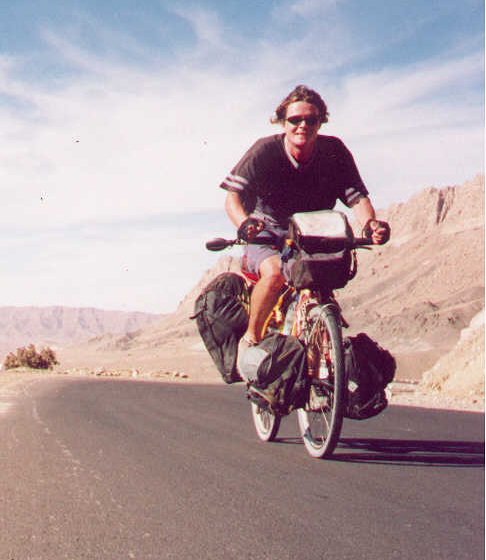
I decided to drop everything and cycle alone from Ireland to India. During nine solo months, I no longer had the reference of my culture, family or friends, I had no internet device, and connections in the places I passed through at that time were very rare. Eight hours a day I would cycle on my own, mostly in silence. I believe that in those long silent solo hours, I discovered meditation, especially during the long featureless desert crossings where there was nothing to observe other than my own mind.
Some years later, I did my first meditation retreat in a Buddhist centre on a quiet mountain in Sri Lanka. I found the experience surprisingly similar to what I had experienced on the bicycle journey – periods of pain mixed with periods of great clarity, all the while aware of my body and mind my mind. I realized that the clarity of mind and peace that meditation can bring were the essence of what I had been drawn to through extreme cycling, and that Buddhist meditation was a more direct route with a tradition and explanation behind it. Since then, I have considered meditation the most significant activity of my life.
In the years that followed, I would often try to sit completely still in the forest for 2 hours at a stretch. While I sometimes had flashes of deep peace and insight, my experience still consisted largely of physical pain and endless thinking. It was a revelation then, when I realized on a visit to India, that Yoga too aimed at deep meditation, and that all of the postures Yogi’s practiced enabled one to sit still for long periods. The postures opened meditation through the development of ease and steadiness in the body (known in yoga as Sukham Sthiram). The postures too could be performed in a meditative way, and it soon became clear that, given the correct attitude, any activity could be a valid vehicle meditation – even cycling! I then became fully dedicated to yoga, always with the outlook of deepening meditation. I practiced a number of styles of yoga for many years, mostly Hatha and Tantra, before finding Ashtanga Vinyasa, which I chose for the challenging and exciting nature of the practice itself.
For 10 years I practiced what is known as the Full Tapa, i.e. a full Ashtanga Series 6 times a week without fail. In the beginning it felt like an adventure, and that itself lifted me. But after many years I reached a plateau, I was no longer making new discoveries in my body and often got through the sequences by will power alone. Then Covid struck. I was no longer able to teach or travel to India to practice with my own teacher. With a strong aversion to “online” Yoga, I found myself practicing alone for two years. With no-one to command otherwise, I drifted, spending more time trying new things, focussing on asanas that had that sense of novelty and adventure. Making sure I included all the important elements of an asana practice, and did not avoid my weaknesses, I created what for me was the most meaningful and inspiring sequence possible. Soon, the same sense of excitement, discovery and awe that I had experienced beginning Ashtanga so many years earlier, returned. After Covid, when I finally went back to practicing the strict Ashtanga sequences in classes, I found it flowing much more easily than before. I had broken through a surprising amount of previous physical barriers. But more importantly, I found a never before felt ease in my body when I sat for meditation, that I could enter into deeper states much faster.
Saoirse is now my daily practice, and through my love of it, a longing to share it has grown in me. I welcome you to share it! If you are new to yoga, it is possible to start directly with the Saoirse method. If you are an Ashtanga practitioner, the method will be easy to understand and you will likely it a way to re-ignite flagging enthusiasm, or a fast track to advancing in the Ashtanga Vinyasa Series. Using the metaphor of music, I like to think of the fixed Ashtanga sequences as the scales. Mastery of the scales allows us to focus on our own music. That music in yoga, is Saoirse.
If you would like to read an introduction to the Saoirse Yoga technique click here.
Hoping to share this practice with you
Namaste
Simon
13-18 August 2025 Saoirse Yoga Meditation and Rewilding (with me, Simon Loughlin)