Rajaswala, “A Menstruating Woman”: Female Health and Empowerment in Nepal
Honouring or limiting, purifying or contaminating, rest-promoting or distress-inducing: which descriptive terms best represent the protocols and views around menstruation in Nepal? Nepal’s cultural tapestry is richly diverse, with approximately 140 distinct ethnic groups and over 120 mother tongues (according to the National Population and Housing Census 2021) in a country whose entire surface area comprises less than one-third the surface area of Spain. Yet, more or less extreme perceptions and practices around menstruation occur across the country, cross-culturally. Throughout this entry, I begin to probe both sides of the story, without venturing deeply into either, which would require an intricate examination of complex historical religio-political views and events occurring not only in Nepal, but in Hinduism generally (for gaining substantial knowledge about these and other features regarding menstruation in Nepal, see Parker et al., Routledge, 2024). Nevertheless, I hope to provide some insight based off of my own experience with the Nepali people I have interviewed or simply spoken with while here, and begin to touch on a few questions that are likely to be met with some controversy: What if protocols for women around the time of menstruation are not always bad? Might they also be partially rooted in female empowerment?
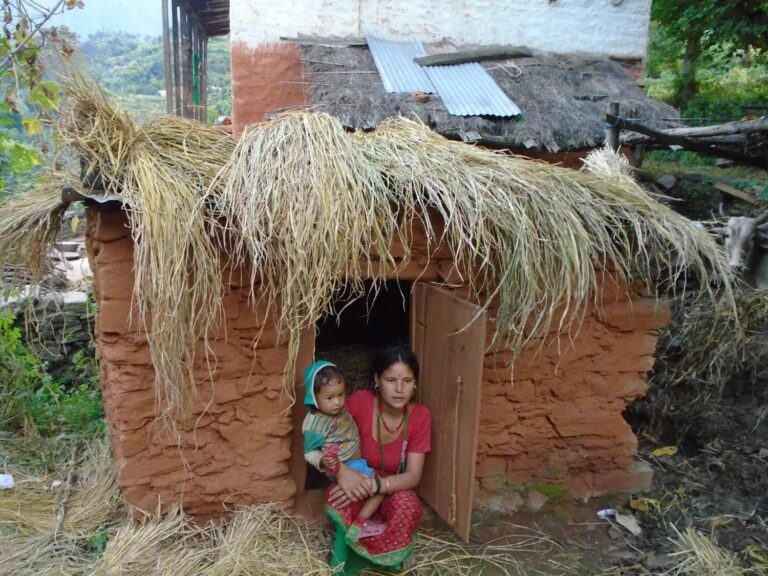
Protocols around menstruation in Nepal are easy to write off as taboo, superstitious, androcentric, and even draconian, especially while considering the notorious ‘chhaupadi’, also known as ‘chaukulla’, ‘chaukudi’ or ‘bahirhunu’ (etc.) which involves women being sequestered to outdoor huts, often animal sheds, whilst menstruating or during childbirth. Despite the practice being outlawed, studies reveal that up to 80% of women in Western Nepal continue to follow chhaupadi protocol, due to community insistence, deeply rooted cultural beliefs, fears and gender biases. Women during these periods – the secretions that occur during menstruation and childbirth – are regarded as impure. Presupposing a woman’s impurity, her presence will therefore “contaminate” the environment she is in. She is told that her touch might spoil food or anger the Gods, threatening the safety of her family and community. In the context of chhaupadi, menstruators live in a small dwelling at the edge of the village, which may be exposed to harsh weather conditions and wild animals. She prepares her own food and is often made to cohabitate with domesticated animals (cows, goats) and may be limited to accessing water resources.
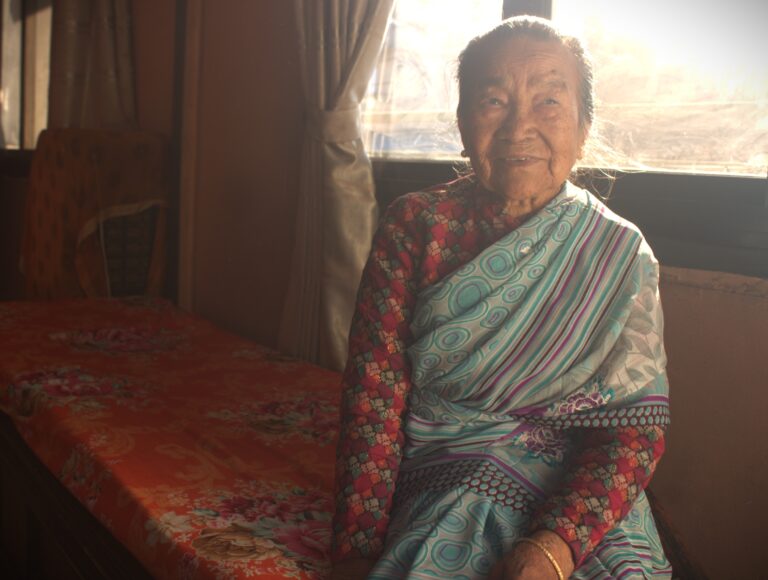
While the extreme practice of chhaupadi is probably confined to certain western regions, milder restrictions occur all over the country, regardless of the family’s caste, level of education or financial situation. During an interview with my friend, 92 year old Thulo Nani Lama of the Swayambhu locality, Kathmandu, I asked if she was required to follow any protocols around the time of her first and subsequent menses. She said that the first time, when she was 16, she had to stay in a room for seven days and was not allowed to see the sun, her father or her brother (men in general). Her mother would bring her food. After seven days, she came out, worshiped the sun, and was gifted a new gunyo cholo, the traditional dress gifted to girls in the lama caste following their first menses. During each proceeding period, she was not made to stay alone in a room away from the sun, but was still required to stay in one place and not allowed to touch many things, including herbs and plants in the garden, religious paraphernalia or food. When I asked her how she felt about having such limitations placed upon her at that time, her initial response was that she did not think about it, did not feel anything in her heart. She said it was something that had been practiced for a very long time, so she was accustomed to that culture and did not feel strange. When her granddaughter (who was translating our conversation) asked again, she added, “Who feels good doing that?? When you are separated, when you cannot touch anyone or anything. But I did not feel anything, I just stayed quiet. I did not have to do anything, so I felt relaxed. But now you can do anything you want, now the superstitious beliefs have been removed, so you can walk freely, go to the kitchen, go to work…”
At this, her granddaughter added, “but I think we do still have restrictions, in doing puja (religious devotional practice), touching the God (religious items) or entering the temple.”
During my current stay in Nepal, I have spoken casually with a relatively small but fairly diverse group of around 50 women and men about their experiences with or perspectives on menstruation. The majority expressed the same sentiments as Thulo Nani Lama and her granddaughter combined. They would, on one hand, assert that these practices no longer applied to them and, on the other, affirm that they (or their female family members) are still restricted when it comes to performing certain behaviours (touching food and going to the temple are the most common) while menstruating. Still others expressed having participated in a practice akin to the one Thulo Nani Lama took part in 76 years ago, in recent times.
The mind that has been conditioned to believe that females and males are equal, so should be treated as equal in every way, completely rejects such a system. In seeking to dismantle practices that seem to amplify gender-based inequality, however, we would be wise to look closely at why such practices arose in the first place, and who is being served by their continued enactment. We can confidently say that physical hygiene was one reason for a woman’s sequestration, and continues to be a factor that modifies women’s behaviour during menstruation in areas that lack water resources or access to appropriate sanitary items. The “why” that one usually reads about in publications about menstruation in Nepal are generally summarized as 1.) The practices are rooted in religiosity and superstition and 2.) The practices are just one more way to reinforce androcentrism within patriarchally driven societies. Both of these presuppositions can be supported through normative Sanskrit literature of South Asia, which present menstruation as a polluting agent, “reinforce(ing) the woman’s position as a potential threat to the orderly functioning of an androcentric social order” (Parker, 2024, p.11). Upon asking a female friend of mine, who lived outside of Kathmandu, if her and her sisters’ roles around the house were very different from those of her brother, she exclaimed, “Of course! He did not have to do anything! We did everything!” She continued to share that in many situations, menstruators were forbidden to touch food (which may result in their eating less) but were still required to do laborious work in the fields and other domestic chores. Yet, in my limited though intimate experience conversing with women of various social groups within Kathmandu proper, each expressed her partial if not complete appreciation of the “restrictions” placed around her during the time of her first and subsequent menses, due to the rest she was afforded by following them.
Such views, which come from women and express an overall appreciation for the codes of conduct during menstruation, may not be representative of Nepali women’s experience during menstruation as a whole. Still, this unexpected finding, that at least a certain population of women appreciate their family’s or culture’s menstruation regulations, demands one to look with greater scrutiny at the historical and modern-day underpinnings of such norms: What if the suggestion that a menstruating woman should stay away from the kitchen and temple provided her with the spiritual grounds for taking a break from cooking or participation in religious functions? What if the requirement for her to sleep in another room in adulthood offered her the opportunity to rest, rather than feeling obliged to comply with the sexual advancements of her husband? What if ceremonial practices of removing oneself from the sun, prior to its worshiping, made sense within a particular cosmological worldview, or were supportive of a young woman’s capacity to draw her senses inward, during what can otherwise be a confusing and emotionally destabilizing time?
Finally, I encourage us to ponder, particularly those of us who are female, mothers and workers (homemakers, career people, etc): Is the social obligation to carry on life as normal (as is usually the case in the West) with all of its psycho-physical demands, any more empowering for women than their being restricted from participating in certain activities, during a time like menstruation or childbirth, when the female body and psyche are naturally facing a significantly greater degree of strain? These are a few of the questions that I believe warrant further examination, as we simultaneously (and rightly) question and oppose any exclusionary practices that threaten a menstruator’s health, safety or dignity.
Conversations around equality for women in Nepal and the world at large must discuss equality as this word relates to female empowerment in the true sense of the word. What if a menstruating woman was, for even a few days, free to decide how she participated in social and domestic spheres, even if her decision was non-participation?
The current blog has been inspired by a personal, sustained interest in Ayurveda, female health and South Asian (specifically Indian and Nepali) history and culture since 2008. It is being written in tandem with my PhD ethnography that will centre around Ayurveda for female health and development in Nepal. My hope is for the blog itself to serve as a platform for community dialogue, conscious critique, education and self-development.