The current blog has been inspired by a personal, sustained interest in Ayurveda, female health and South Asian (specifically Indian and Nepali) history and culture since 2008. It is being written in tandem with my PhD ethnography that will centre around Ayurveda for female health and development in Nepal. My hope is for the blog itself to serve as a platform for community dialogue, conscious critique, education and self-development.
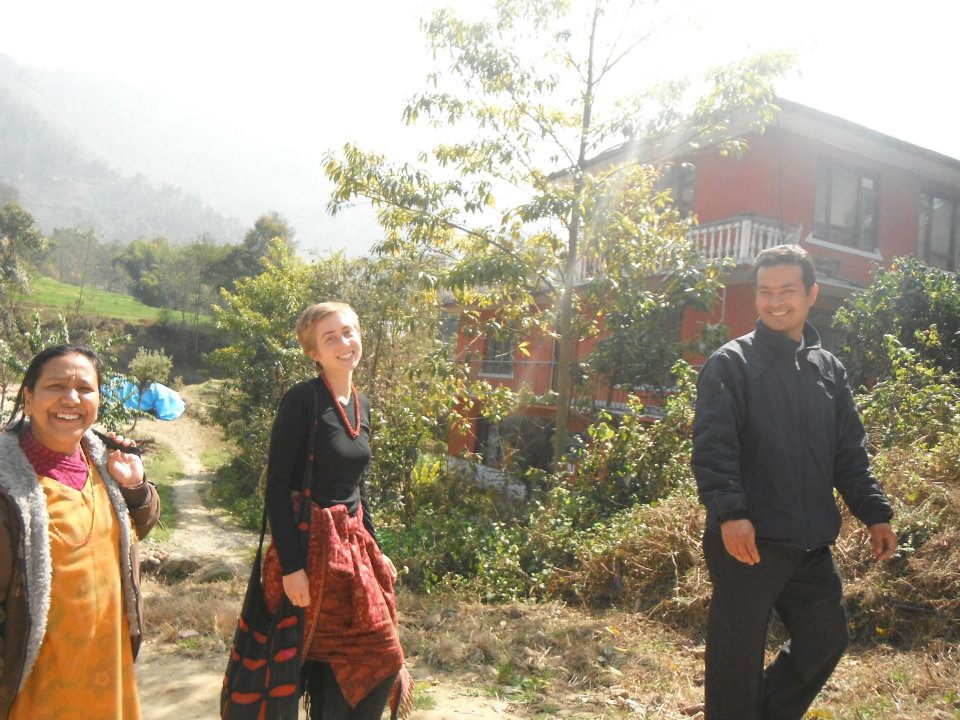
Sipadol, Nepal, 2012. Dr. Sarita Shrestha, Alyson and Dr. Kumar.
As present-day research on Ayurveda increases, ever more attention is moving towards pharmacy, industrialized levels of pharmaceutical production, and academic textual research (Smith and Wujastyk, 2008). Still, insufficient formal investigations have recorded the ways that Ayurveda is actually being practiced in real-life settings, and the dynamic treatment modalities that are provided therein (Puthiyedath, 2013).
I began my relationship with Ayurveda, Nepal, and Nepali female development in 2008, a few weeks after turning 18, on a trip to one of Nepal’s poorest regions in the Western Terai, along with a short but impactful journey through Northwestern India. At the time, I had no intention of converting anything from that experience into a study of greater proportion. Yet in retrospect, that period appears to have influenced my entire life trajectory to date: While studying ethnomedicine in Washington State, I received a university grant between 2011-2012 to explore Ayurveda in Nepal and India, a project which led me to connecting with Nepal’s first female ayurvedic doctor/OB-GYN, Sarita Shrestha (see blog entries from that period in, The Cosmic Life, and Ayurveda); I subsequently turned my focus to the study of yoga asana and philosophy; founded Asturias Yoga; then in 2023, completed a MRes writing a thesis on Sāṃkhya, the philosophy undergirding both ayurvedic and yogic practice (see Reconceptualizing puruṣa within the Sāṃkhya-kārikā – White Rose eTheses Online).
Life has been full. Developing as a woman and mother of two children living many months of the year off grid comes with its own joyous though rigorous educational curriculum. Still, upon leaving Nepal in 2012, I did not feel my time with Dr. Shrestha (Sarita) was complete; the desire to support her work has remained alive in me ever since. Sarita’s approach to healing, which was at once improvisatory and intuitive yet deeply rooted in ayurvedic classicality, decades of experience and a proficiency in biomedicine, fascinated me. Upon observing her success over the course of many months in treating a variety of gynaecological, mental and other afflictions (applying classical and innovative ayurvedic approaches to healing) I became charged with the conviction that her way of practicing Ayurveda warranted formal documentation, both for its contribution to the field of medical anthropology, as well as for its potential contribution to female health throughout Nepal on a larger scale. At the time, however, the committee chair of the grant that was funding my work explicitly discouraged me from treating my experience academically, urging me to use the grant as it was intended to be used: for embracing experiential learning purely, that is, without being obliged to produce any fixed results. She reminded me that my academic pursuits henceforth were unlikely to permit such freedom. And she was right — being in the position of the observer, free from attachments to the outcome, provided me with a unique perspective from which to view the reality I found myself living.